Help Restore the Chinese Mission Hall
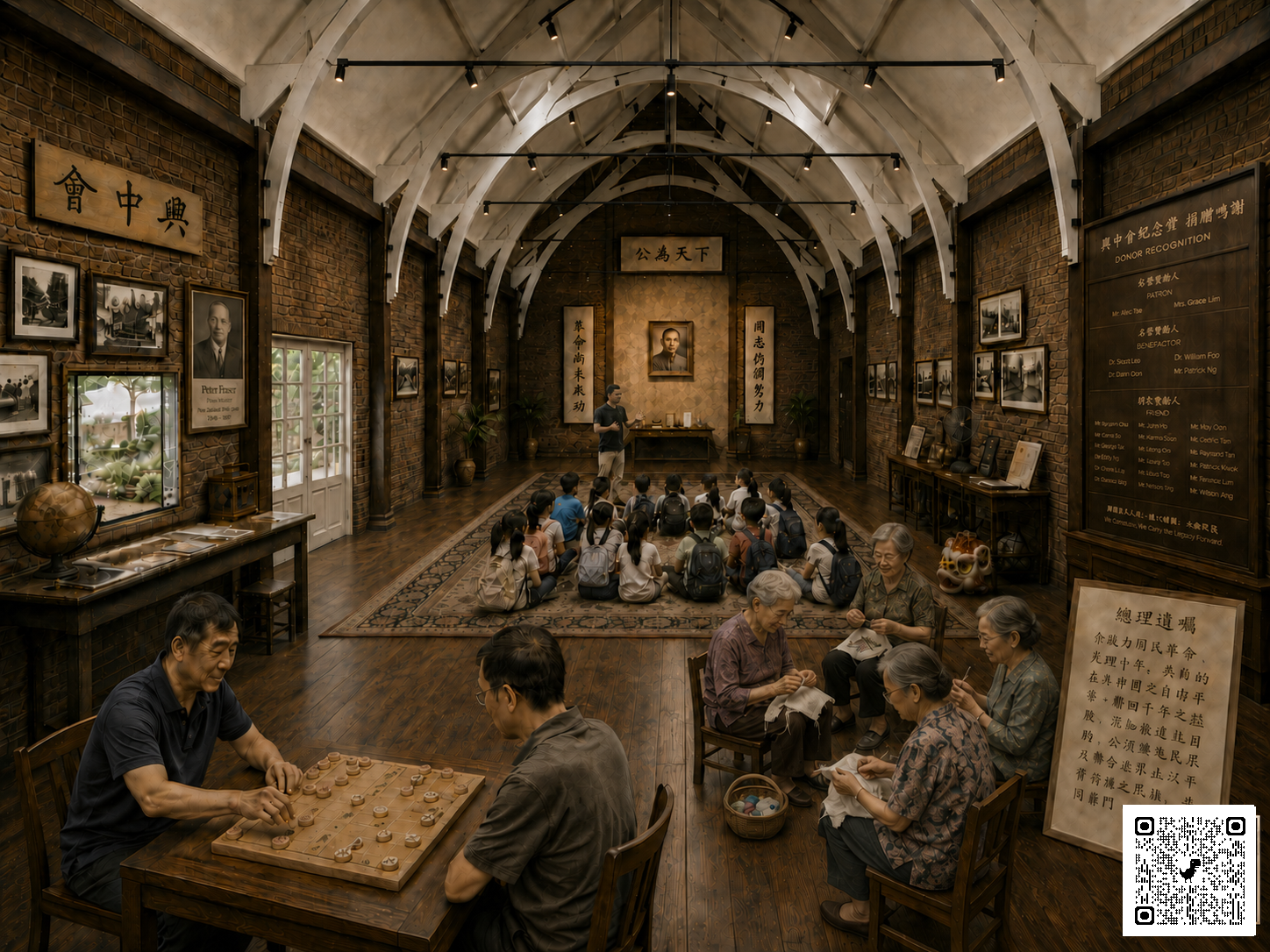
An aspirational vision of the Mission Hall restored to community life. AI enhanced image based on archaus drawings.
The historic Chinese Mission Hall in Frederick Street, Wellington, was built in 1905 to serve the religious and community life of Wellington’s Chinese people; it provided a place for Christian worship, gathering, mutual support and the maintenance of community ties.
We are exploring the purchase and restoration of the Hall so that it can once again fulfil that purpose: as a living Chinese community centre where culture is not merely remembered or displayed, but practised and passed on.
Chinese culture cannot be preserved through ancestry, photographs and museum cases alone. It survives when people gather, speak the language, play the games, practise calligraphy and painting, observe traditions, share food, tell stories and form relationships across generations.
The Mission Hall would provide a place where that living culture can continue.
More than the preservation of a building
The proposal is not simply to save an old building or create a conventional museum.
The Hall itself is part of the history of Wellington’s Chinese community, but its greatest value lies in returning it to active use. Its heritage would be preserved by allowing Chinese communal life to take place within it once again.
A weekday gathering of seniors, a mahjong game, calligraphy on the walls, tai chi in the adjoining park, children hearing Cantonese, families celebrating a festival and newcomers meeting established communities would all be forms of cultural preservation.
Historical displays would help explain the Hall and the people connected with it, but they would form the setting for community life rather than displace it.
Yes; the ownership point is repeated. Keep the financial section focused on funding and tax deductibility, then leave governance and operation to the next section.
Is the project financially realistic?
The proposal does not rely solely upon individual donations.
The Tung Jung Association is considering contributing 25% of the purchase cost. The Seyip and Poon Fah Associations would also consider a matching 25% of the purchase price, which remains subject to final approval. Both contributions would be subject to agreement on the purchase price, governance structure and final terms.
We are seeking significant support towards the balance from the Chinese Poll Tax Heritage Trust, reflecting the Hall’s close association with the generations who lived under the Poll Tax and other discriminatory restrictions.
Those early Chinese communities formed associations, missions and mutual-support networks because they often had nowhere else to turn. Restoring the Mission Hall as a place of gathering and support would continue that legacy rather than merely commemorate it.
We will also approach other charitable, cultural, heritage and community funders. Community pledges, business sponsorship and individual donations will demonstrate that the proposal has broad support and may contribute towards the purchase, establishment costs, accessibility improvements and an initial operating reserve.
Eligible donations made to the charitable trust established for the project will qualify for New Zealand donation tax credits once the trust has the necessary charitable and donee status.
No payment is required at this stage. This pledge form is intended to measure community support and help determine whether there is a realistic pathway to purchasing the Hall.
Who would own and operate the Hall?
The Hall would be owned and operated by an independent charitable trust.
The trust would be responsible for:
- protecting the building for long-term community use;
- managing its finances, bookings and maintenance;
- ensuring sound governance and annual reporting;
- working with participating Chinese associations and community groups;
- encouraging regular social, cultural and educational activities;
- developing appropriate historical interpretation;
- seeking grants, sponsorship and other financial support.
The building would be held for charitable and community purposes and not for the private benefit of any individual.
The intention would be to create a shared home rooted in Wellington’s historic Chinese communities while remaining welcoming to newer migrants and the wider public.
How would annual running costs be funded?
Purchasing the Hall is only worthwhile if it can remain active and financially sustainable.
Likely annual expenses would include insurance, rates if applicable, electricity, water, internet, cleaning, routine maintenance, accounting, administration, security and compliance costs.
These would be met through a mixture of:
- annual contributions from participating associations;
- regular hire by seniors’ groups, clubs and community organisations;
- private and community-event hire;
- supporter memberships and annual donations;
- charitable, cultural and community grants;
- programme-specific funding;
- business sponsorship;
- fundraising and cultural events.
An established Chinese seniors’ organisation has already expressed interest in hiring the Hall and using the adjoining park for tai chi. It currently operates weekday drop-in centres in Wellington and Lower Hutt, with painting, calligraphy and other social activities.
This suggests that the Hall would not need to invent a community of users. It could provide a culturally familiar home for activities that are already taking place in generic hired rooms.
The charitable trust would develop a mixed-income model and would not proceed with the purchase without a credible plan for meeting the Hall’s continuing expenses.
Why this building, and why now?
The Mission Hall is one of the few surviving places directly connected with the everyday life of Wellington’s early Chinese community.
Its significance lies not only in the building itself, but also in its location within Wellington’s former Chinese quarter. This may be the last realistic opportunity to establish a Chinese community museum and cultural centre in an authentic historic Chinese setting. A modern room elsewhere could host the same activities, but it could not recreate the connection between the building, the neighbourhood and the people whose stories would be told there.
Its location also offers practical advantages:
- a central Wellington position;
- bus services nearby on Taranaki Street;
- a new public park immediately beside the Hall;
- proximity to Chinese restaurants and community facilities;
- indoor and outdoor space suitable for social and cultural activities.
For older Chinese residents, a room containing Chinese calligraphy, paintings, familiar images and the history of their community could feel quite different from a neutral municipal meeting room.
It could feel like somewhere they belong.
How would culture be lived in the Hall?
Possible activities include:
- a weekday drop-in centre for Chinese seniors;
- mahjong and Chinese chess;
- tai chi in the adjoining park;
- calligraphy, painting and traditional arts;
- Cantonese and Mandarin language activities;
- shared meals and tea;
- talks, workshops and community meetings;
- festivals and cultural observances;
- support and information for newer migrants;
- intergenerational activities;
- exhibitions on Chinese life in Wellington and New Zealand.
These are not merely recreational activities added to a heritage building. They are the means by which culture is maintained.
When people practise calligraphy rather than merely look at an old example, speak Cantonese rather than merely record that their ancestors spoke it, or gather for festivals rather than merely display photographs of past celebrations, they keep that culture alive.
The Mission Hall would preserve Chinese New Zealand heritage by making it possible to continue living it.
Heritage and historical interpretation
Historical interpretation would be introduced gradually and could include:
- the history of the Chinese Mission Hall;
- the Poll Tax era and early Chinese life in Wellington;
- the work of Chinese associations and mutual-support organisations;
- family histories, photographs and documents;
- connections between New Zealand Chinese communities and events in modern Chinese history;
- temporary exhibitions developed with museums and cultural institutions.
The Hall would have museum-quality interpretation, but it would not become a silent museum.
Its history would be visible around the people using it. The past and present would occupy the same room.
What does a pledge mean?
A pledge is an indication of support only.
It is not legally binding, and no payment will be requested unless and until:
- a purchase agreement has been reached;
- satisfactory due diligence has been completed;
- the charitable trust and governance arrangements are established;
- the principal funding requirements have been met; and
- there is a credible operating budget.
Pledges will help demonstrate to major funders that the project has genuine community backing and help determine whether the Mission Hall can realistically be secured for future generations.
Supporting this project is not simply contributing to the purchase of a building.
It is helping provide a place where Chinese culture can continue to be lived, shared and passed on.